
- By cyond
- No Comments
- Water Leaks
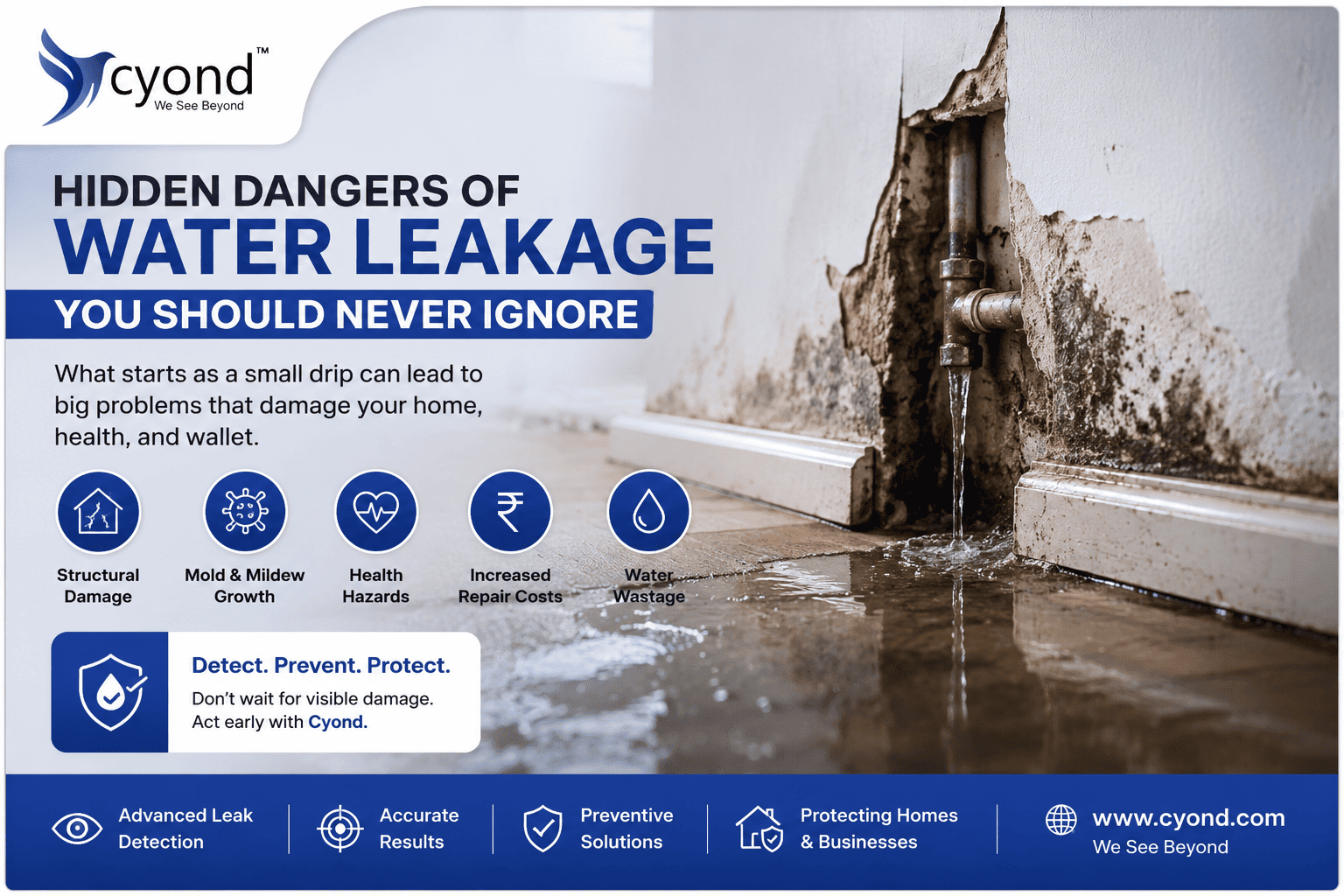
Whenever there is a leak, people usually think it’s just a plumbing issue. And other issues like a damp patch, paint peeling or a musty smell don’t seem really serious. But what many homeowners fail to realize is that hidden leakage silently damages the structure of a building long before any of the visible signs appear. By the time cracks begin to spread or walls start weakening, the damage turns very expensive, stressful and sometimes irreversible.
What makes water leakage dangerous is not the water itself. It is the slow destruction happening behind walls, inside slabs, beneath tiles and around steel reinforcements where nobody notices until it is too late.
Why Water Leakage Is More Dangerous Than Most People Think
People usually react only when water starts dripping from ceilings or flowing visibly through walls. But hidden leakage behaves differently. It spreads quietly through concrete, brick, plaster and steel for months or even years.
A small unnoticed leak can eventually lead to:
- Weakening of structural columns and beams
- Rusting of steel reinforcement bars
- Electrical hazards inside walls
- Mold growth affecting indoor air quality
- Damage to flooring, woodwork, and furniture
- Reduction in property value
- Expensive structural repairs
What makes this worse is that many buildings in cities like Hyderabad face leakage issues because of changing weather conditions, poor waterproofing methods, aging pipelines and rushed construction practices.
This is exactly why professional water leakage diagnosis in Hyderabad has become increasingly important for homeowners, apartment associations, and commercial property owners.
The Silent Structural Damage Happening Behind Your Walls
Concrete Is Not Waterproof
One of the biggest misconceptions in construction is assuming concrete naturally blocks water. It does not.
Concrete contains tiny pores. When leakage occurs repeatedly, water slowly travels through these pores and reaches the steel reinforcement bars inside the structure.
Once moisture reaches steel, corrosion begins.
What Happens After Steel Starts Rusting?
Steel expands when it rusts. As it expands, it creates pressure inside the concrete. This leads to:
- Surface cracks
- Bulging plaster
- Ceiling damage
- Concrete spalling
- Weakening of load-bearing capacity
This process is slow but extremely dangerous because the structure may look normal from outside while internal deterioration continues.
Many property owners only realize the seriousness after consulting experts for water leak detection and repair, when hidden corrosion has already spread across major sections of the building.
The Smell You Ignore Could Be Toxic
Mold Growth Is More Serious Than You Think
That damp smell near bathrooms or kitchens is not “normal moisture.” It is often an early warning sign of fungal growth.
Hidden leaks create humid environments where mold thrives. Over time, mold spores spread through air-conditioning systems, walls, curtains, mattresses, and furniture.
Health Problems Linked to Indoor Mold
People exposed to mold for long periods often experience:
- Constant sneezing
- Breathing difficulty
- Allergic reactions
- Skin irritation
- Headaches
- Asthma flare-ups
- Chronic sinus issues
Children and elderly family members are usually affected first.
The dangerous part is that mold often grows behind tiles, under wooden flooring, or inside false ceilings where it remains invisible for months.
This is why advanced water leak detection service methods now include moisture mapping and thermal inspections instead of relying only on visible signs.
Why Paint Damage Is Usually the Last Warning Sign
Most homeowners panic only after seeing peeling paint or damp patches. But by then, leakage has usually existed for a long time.
What Happens Before Paint Starts Peeling?
Before visible wall damage appears, water may already have:
- Saturated internal plaster layers
- Damaged electrical conduits
- Weakened cement bonding
- Triggered fungal growth
- Spread into adjacent rooms
Think of wall stains as the “final symptom,” not the beginning of the problem.
Professional teams offering water leakage diagnosis in Hyderabad often find that the source of leakage is nowhere near the visible stain. Water travels unpredictably through slabs and walls before appearing on surfaces.
That is why guessing the source usually wastes money and delays proper repair.
Hidden Electrical Risks Most People Never Consider
Water and Wiring Are a Dangerous Combination
One of the most overlooked dangers of leakage is electrical failure.
Water entering concealed wiring systems can lead to:
- Short circuits
- Power fluctuations
- Appliance damage
- Fire hazards
- Electric shocks
Many old apartment buildings experience repeated tripping issues because moisture slowly enters electrical pathways hidden inside walls.
Signs That Leakage May Be Affecting Electrical Systems
- Flickering lights
- Burning smell near switchboards
- Sudden MCB trips
- Warm wall surfaces
- Buzzing sounds near sockets
Ignoring these signs can become life-threatening.
Experienced water leak specialized agencies in Hyderabad often coordinate with electrical teams because leakage-related wiring damage is more common than people realize.
The Real Cost of Ignoring a Small Leak
A Minor Repair Can Become a Major Structural Expense
People delay repairs thinking they are saving money.
In reality, delayed action usually multiplies the final repair cost.
Example of How Costs Escalate
| Stage | Typical Issue | Approximate Repair Impact |
| Early Stage | Small pipe leakage | Minor plumbing repair |
| Mid Stage | Damp walls and tile damage | Waterproofing and replastering |
| Advanced Stage | Corroded reinforcement steel | Structural rehabilitation |
| Severe Stage | Beam/slab weakening | Major reconstruction |
The difference between early action and delayed action can easily become lakhs of rupees.
That is why modern water leak detection and repair methods focus heavily on identifying hidden problems before structural damage spreads further.
Why Leakage in Bathrooms Is Often Misdiagnosed
Bathrooms are among the most common leakage zones, but also the most misunderstood.
The Problem Is Not Always the Pipe
Many homeowners immediately break tiles assuming pipe failure is the reason.
But leakage can also happen because of:
- Failed waterproofing membranes
- Improper tile grouting
- Floor slope issues
- Cracks around drain traps
- Pipe joint gaps
- Wall-floor junction failure
Unnecessary tile removal often creates bigger expenses without solving the original issue.
Advanced water leak detection service providers now use non-invasive techniques like:
- Thermal imaging
- Pressure testing
- Acoustic leak detection
- Moisture meters
These methods help identify the exact source without blindly damaging the property.
Terrace Leakage Is Slowly Destroying Thousands of Buildings
Sunlight and Rain Together Create Structural Stress
Terraces face extreme weather exposure throughout the year.
In Hyderabad especially, buildings experience:
- High summer temperatures
- Sudden heavy rains
- Expansion and contraction of concrete
- Waterproof coating deterioration
Over time, terrace cracks begin allowing water seepage into slabs.
Common Signs of Terrace Leakage
- Ceiling dampness after rainfall
- White salt deposits on walls
- Cracks near roof corners
- Bubbling paint on upper floors
- Water dripping during monsoon
Unfortunately, many people apply temporary waterproof coatings without addressing underlying structural cracks.
This is where proper water leakage diagnosis in Hyderabad becomes critical because superficial fixes rarely solve recurring terrace leakage problems.
How Leakage Damages Property Value
Buyers Notice Water Damage Immediately
Even beautifully designed homes lose market value when leakage signs appear.
Visible dampness creates the impression that:
- The building is poorly maintained
- Structural quality is weak
- Hidden repair costs may exist
- Future maintenance will be expensive
Real estate buyers today are more cautious than ever.
Many apartment associations now proactively hire water leak specialized agencies in Hyderabad before resale or rental listings because unresolved leakage directly impacts property pricing.
Hidden Leakage Inside Plumbing Shafts
The Most Ignored Area in Apartment Buildings
In many apartments, leakage starts inside concealed service shafts.
These narrow spaces contain:
- Drainage pipes
- Water supply lines
- Sewage connections
- AC drain pipes
Because shafts remain closed most of the time, leaks continue unnoticed for months.
Common Warning Signs
- Damp smell near utility areas
- Continuous wall moisture
- Neighbor complaints below your flat
- Black patches near shaft walls
The difficult part is that leakage inside shafts often spreads vertically across multiple floors.
Professional water leak detection and repair teams use specialized inspection equipment to trace leakage movement across interconnected pipelines.
Why Temporary Repairs Usually Fail
Surface Solutions Rarely Fix Internal Problems
Many people rely on quick fixes like:
- Waterproof paint
- Silicone fillers
- Cement patchwork
- DIY sealants
These methods may hide symptoms temporarily but rarely solve the root issue.
Water always finds the weakest path.
Unless the actual source is identified properly, leakage returns again, often worse than before.
Reliable water leak specialized agencies in Hyderabad focus first on diagnosis instead of immediately starting repair work. This approach saves both time and long-term repair costs.
Modern Leak Detection Technology Most People Don’t Know About
Leak detection today is very different from old trial-and-error methods.
Advanced Techniques Used Today
Thermal Imaging
Detects hidden moisture behind walls and floors using temperature variations.
Acoustic Detection
Uses sound frequency analysis to identify underground or concealed pipe leaks.
Moisture Mapping
Measures moisture concentration inside structures to identify spread patterns.
Pressure Testing
Checks plumbing systems for pressure drops indicating hidden leaks.
Endoscopic Inspection
Uses small cameras to inspect concealed areas without major demolition.
Modern water leak detection service providers use these technologies to minimize unnecessary breaking and reduce repair disruption.
FAQs
A. Some early signs include musty smell, peeling paint, damp walls, higher water bills, mold growth, cracked plaster, and recurring moisture patches.
A. Many repairs fail because the exact source was never diagnosed correctly. Water often travels far from the visible damp area.
A. Early-stage repairs are usually affordable. Delayed repairs involving structural damage become significantly more expensive.
A. Heat causes expansion and contraction in concrete, tiles, and pipes. Existing cracks widen during extreme temperatures, allowing deeper water penetration later.
A. Yes. Water travels through slabs, shafts, and wall joints, meaning one flat’s leakage can damage neighboring units.
A. Absolutely. Hidden leakage may remain trapped inside walls or slabs for months before becoming visible.
What Smart Homeowners Do Differently
They Treat Leakage as a Structural Warning
People who avoid major building damage usually follow three simple steps:
- They act immediately after spotting early signs
- They avoid temporary patchwork solutions
- They rely on professional diagnosis instead of assumptions
Today, advanced water leakage diagnosis in Hyderabad helps property owners identify hidden risks before they become dangerous structural problems.
The smartest investment is not repairing visible damage. It is preventing invisible damage from spreading further.
Conclusion
Water leakage is never just about stains, damp patches, or peeling paint. Behind every ignored leak, there could be weakening concrete, rusting steel, mold growth, electrical danger, and rising structural repair costs. The earlier the problem is diagnosed, the easier and safer the solution becomes. Hidden leakage does not disappear on its own. It spreads quietly until the damage becomes impossible to ignore.
At Cyond, expert inspection methods and advanced diagnostic techniques help identify hidden structural risks before they turn serious. Whether it is terrace seepage, concealed plumbing leakage, or recurring dampness, professional support can save your building from long-term structural damage.
Follow us on Instagram.